Posted on 5th Nov 2026
Modern industrial facilities depend on advanced electrical equipment, automation systems, Variable Frequency Drives (VFDs), servo motors, UPS systems, rectifiers, and other power electronic devices to maintain efficient production. While these technologies improve operational performance, they can also introduce electrical disturbances known as harmonics.
Harmonic distortion is one of the major challenges affecting industrial power quality. It can lead to overheating, equipment malfunction, increased electrical losses, unexpected downtime, and higher maintenance costs. To address these challenges, industries are increasingly adopting advanced power quality solutions.
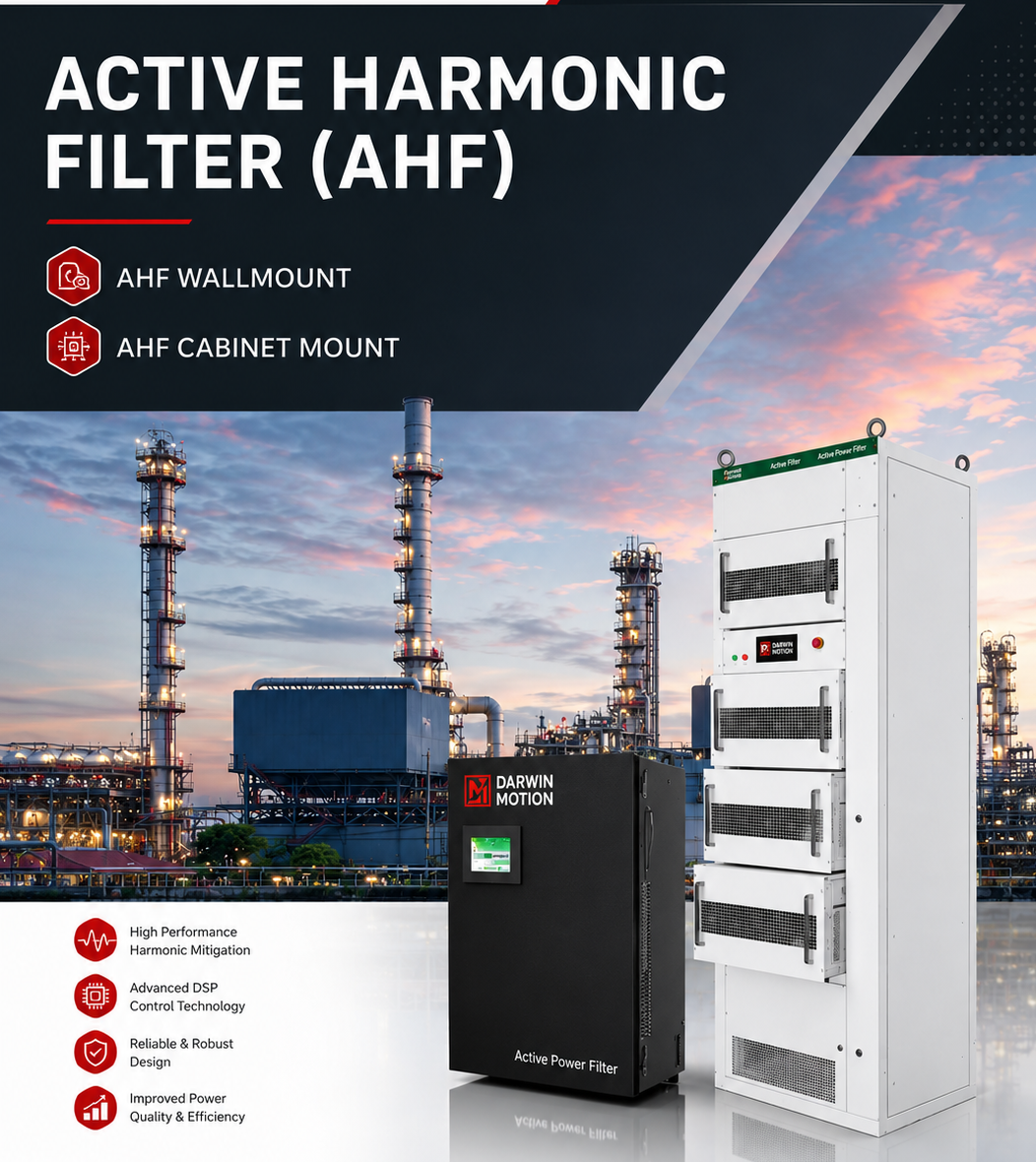
An Active Harmonic Filter is an advanced electrical device designed to detect and compensate unwanted harmonic currents in real time. By reducing harmonic distortion, it helps maintain a cleaner electrical supply and improves the overall reliability of industrial power distribution systems.
As a Darwin Motion AC Drive manufacturer, Darwin Motion focuses on industrial automation, motor control, and power quality solutions that support reliable and efficient industrial operations.
An Active Harmonic Filter (AHF) is a power electronic device that continuously monitors electrical current and identifies unwanted harmonic components generated by nonlinear loads.
Once these harmonic components are detected, the filter generates and injects compensating currents with corresponding amplitudes and opposite phase angles. These currents counteract the unwanted harmonics, reducing their impact on the electrical distribution network.
Unlike conventional passive filters that are designed to operate at specific harmonic frequencies, active filters can dynamically respond to multiple harmonic orders and changing load conditions.
Harmonics are generated when electrical equipment draws current in a non-sinusoidal waveform, even when the supplied voltage is approximately sinusoidal. Such equipment is commonly classified as nonlinear loads.
Common industrial sources of harmonics include:
When multiple nonlinear loads operate simultaneously, harmonic currents can accumulate and affect the overall electrical distribution network.
An Active Harmonic Filter works through continuous monitoring, intelligent signal processing, and real-time current compensation. It identifies harmonic components in the electrical system and produces an opposing current to minimize the resulting distortion.
Current transformers (CTs) continuously monitor the electrical current drawn by industrial loads. The measured signals provide information about the load current waveform and its harmonic content.
The filter's digital control system analyzes the measured signals to identify unwanted harmonic components and determine the compensation current required.
Using power electronic switching devices, the filter generates compensating currents that have the required harmonic components with opposite phase angles.
The compensating current is injected into the electrical network, counteracting the harmonic currents generated by nonlinear loads. This reduces the harmonic distortion seen by the power source.
The filter continuously monitors changing load conditions and adjusts its compensation output accordingly, helping maintain improved power quality during varying industrial operating conditions.
Power quality directly influences industrial productivity, electrical equipment performance, and operational reliability. Harmonic distortion can create several problems throughout a plant's electrical network. An appropriately designed Active Harmonic Filter helps address these issues through dynamic harmonic compensation.
Total Harmonic Distortion (THD) indicates the level of harmonic components present in an electrical waveform. Higher harmonic distortion can affect the performance of connected equipment.
An Active Harmonic Filter reduces unwanted harmonic currents and helps maintain cleaner current waveforms. This supports better electrical performance and helps industries work toward applicable power quality requirements.
Excessive harmonics can increase electrical heating and stress in transformers, motors, cables, and distribution equipment. Over time, this may contribute to premature equipment deterioration.
By mitigating harmonic currents, an active filter helps reduce harmonic-related stress and supports the reliable operation of electrical assets.
Harmonic currents contribute to additional losses in electrical distribution components. Reducing these currents can help minimize unnecessary heating and electrical losses in transformers, cables, and other equipment.
Certain Active Harmonic Filters offer reactive power compensation along with harmonic mitigation. When this functionality is enabled and correctly configured, the system can improve displacement power factor and support better overall power factor performance.
Electrical disturbances can cause sensitive equipment to malfunction, protective devices to trip, and production processes to stop unexpectedly.
Improved harmonic control helps create a more stable electrical environment, supporting continuous production and reducing harmonic-related operational interruptions.
Industrial production environments rarely operate under constant electrical loads. Equipment may start, stop, or change operating conditions throughout the production cycle.
Active Harmonic Filters dynamically adjust their compensation output according to changing harmonic requirements, making them suitable for facilities with variable and complex electrical loads.
Both active and passive harmonic filters are used to reduce harmonic distortion. However, their operating principles, flexibility, and application requirements are different.
The appropriate solution depends on harmonic measurements, load characteristics, electrical network configuration, installation requirements, and project economics.
Industries operating multiple power electronic devices can benefit from effective harmonic mitigation. Active Harmonic Filters are particularly useful in facilities where electrical loads frequently change or several nonlinear loads operate simultaneously.
Manufacturing facilities use CNC machines, automated production lines, motor drives, and electronic control systems. Active filtering helps manage harmonics generated by these interconnected systems.
Textile manufacturing relies on spinning machines, winding systems, motors, and variable frequency drives. Harmonic mitigation supports improved electrical performance across production equipment.
Steel plants and metal processing facilities operate heavy electrical loads, rolling mills, welding systems, and furnace equipment. Appropriate harmonic mitigation can help improve power quality and electrical system stability.
Automotive manufacturing facilities use robotic systems, welding machines, conveyor drives, and automated assembly equipment. Active harmonic filtering helps manage disturbances from these power electronic loads.
Large HVAC installations use multiple variable-speed drives, compressors, pumps, and electronic control equipment. Active filters can help reduce harmonic distortion across these systems.
Water treatment facilities use pumps, blowers, motors, and variable-frequency drive systems. Maintaining good power quality supports dependable operation of critical pumping and treatment equipment.
Selecting the right filter requires a proper understanding of the electrical distribution system and the harmonic problems affecting the facility. Choosing equipment only on the basis of its current rating may result in inadequate compensation.
IEEE 519 is a widely recognized recommended practice for controlling harmonic distortion in electrical power systems. It establishes harmonic control guidelines at the Point of Common Coupling (PCC) between the consumer and the utility network.
Industrial facilities with significant nonlinear loads may need to evaluate their harmonic distortion levels against the applicable requirements of IEEE 519.
An appropriately selected and installed Active Harmonic Filter can help reduce current harmonic distortion and support efforts toward meeting applicable harmonic limits. However, actual compliance depends on several factors, including system configuration, short-circuit capacity, load characteristics, and measurement conditions.
A professional power quality audit is recommended before selecting a harmonic mitigation solution.
Choosing the right industrial technology partner is important for maintaining efficient machinery, reliable electrical systems, and consistent production performance.
Darwin Motion AC Drive manufacturer provides industrial automation and electrical drive solutions designed to address the evolving requirements of modern industries. With a focus on motor control, automation, and power quality, Darwin Motion offers solutions for industrial facilities looking to improve operational performance.
Whether your facility operates multiple VFDs, automated machinery, industrial pumps, compressors, or other nonlinear loads, evaluating the right harmonic mitigation solution can make a significant difference to electrical system performance.
Power quality is an essential part of modern industrial operations. As industries increasingly adopt automation, variable-speed drives, and advanced power electronic equipment, managing harmonic distortion becomes increasingly important.
An Active Harmonic Filter provides a dynamic approach to harmonic mitigation by continuously monitoring electrical loads and injecting compensating currents. This helps reduce harmonic distortion, minimize electrical losses, protect connected equipment, and support reliable industrial operations.
For industries looking to improve electrical performance and optimize their power distribution systems, choosing the right harmonic filtering technology is an important investment.
Looking for reliable industrial automation and power quality solutions? Connect with Darwin Motion AC Drive Manufacturer to explore Active Harmonic Filter solutions designed for modern industrial requirements.
Take the next step toward better power quality and more reliable industrial operations.
Explore Our Solution: Active Harmonic Filter – Darwin Motion


