Posted on 20th Sep 2026
Modern CNC machines use sophisticated servo drives, spindle drives, variable frequency drives, controllers, and other power electronic components to achieve high-speed and precise manufacturing. While these technologies improve productivity and machining accuracy, they can also generate harmonic currents that affect the electrical network.
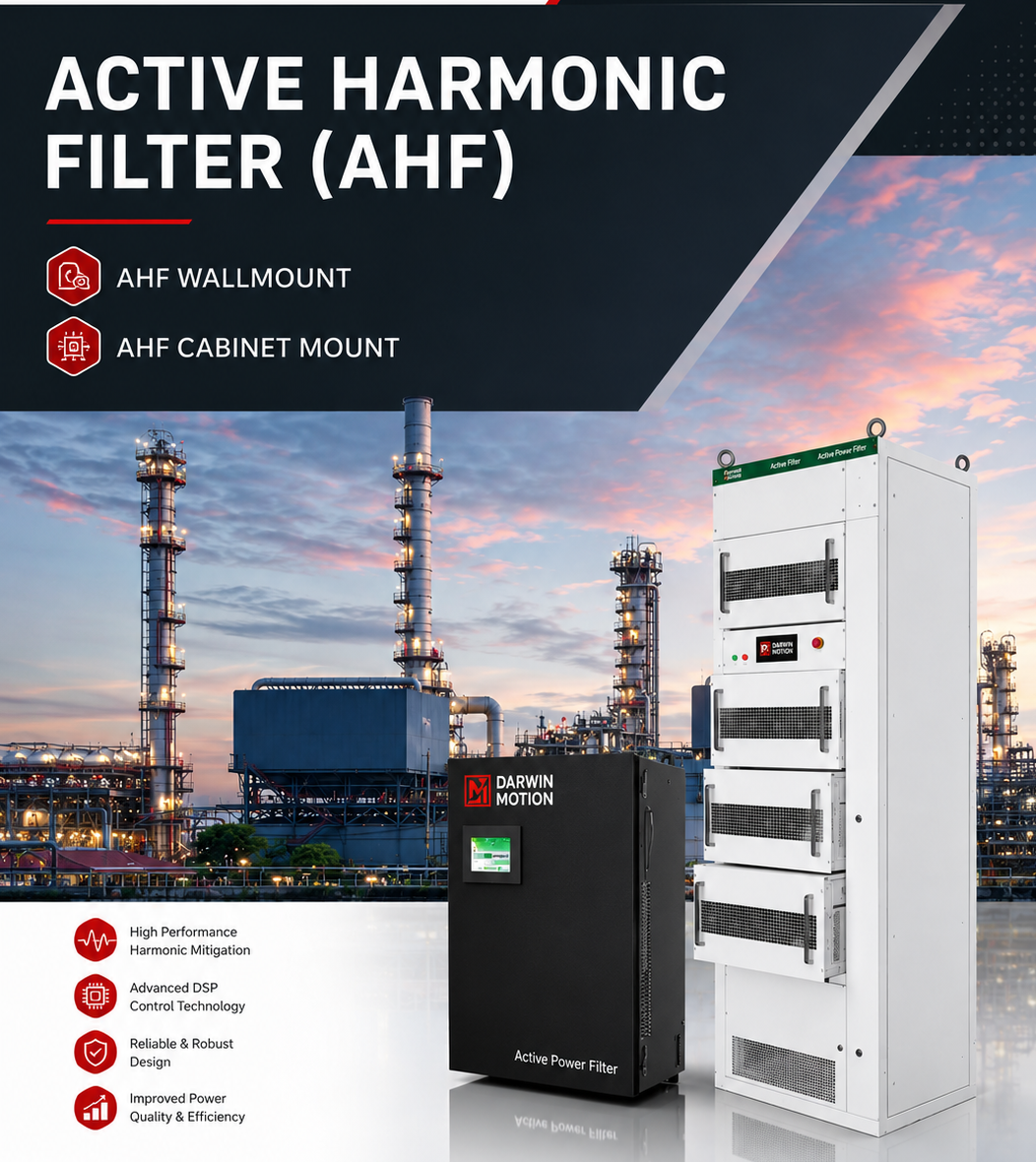
A Harmonic Filter for CNC Machine can help control unwanted harmonic distortion, improve power quality, reduce electrical losses, and support reliable operation of CNC equipment. Darwin Motion AC Drive Manufacturer provides advanced Active Harmonic Filter solutions designed for industrial environments where stable and reliable power quality is essential.
CNC machines contain several electronic power conversion stages. Servo drives, spindle drives, rectifiers, inverters, and other nonlinear loads can draw current in a distorted waveform instead of a smooth sinusoidal waveform. These distorted currents introduce harmonic components into the electrical distribution system.
When multiple CNC machines operate simultaneously, harmonic currents can accumulate and affect shared electrical infrastructure such as transformers, cables, switchgear, capacitor banks, and other connected equipment.
Excessive harmonic distortion can affect the overall electrical performance of a CNC manufacturing facility. The impact depends on the system configuration, harmonic levels, equipment characteristics, and operating conditions.
Harmonic currents can increase losses in transformers, cables, motors, and switchgear. Higher losses may result in additional heating and can contribute to reduced equipment operating life.
Harmonic currents flowing through system impedance can contribute to voltage waveform distortion. This may affect sensitive electronic and automation equipment connected to the same electrical network.
Excessive distortion can contribute to unwanted operation of protective devices and may affect the stable operation of drives and other electronic equipment.
Power factor correction capacitor banks can be affected by harmonic currents and resonance conditions. Proper harmonic assessment is therefore important before installing or expanding capacitor-based power factor correction systems.
Additional harmonic current increases electrical losses in conductors and transformers. Reducing unnecessary harmonic currents can help improve the overall electrical efficiency of the distribution system.
An Active Harmonic Filter continuously monitors the electrical current waveform and identifies unwanted harmonic components. It then generates compensating currents that oppose the detected harmonic currents.
This real-time compensation helps reduce harmonic distortion and improves the quality of current supplied through the electrical network. Active Harmonic Filters can also provide reactive power compensation and three-phase load balancing depending on the selected configuration.
CNC production facilities often have rapidly changing electrical loads because machines may accelerate, decelerate, start, stop, or operate at different machining speeds. Active Harmonic Filters are suitable for such dynamic environments because they can continuously respond to changing load conditions.
Compared with conventional passive filtering approaches, an Active Harmonic Filter can dynamically respond to variations in harmonic currents. This makes active filtering particularly useful in manufacturing facilities where CNC machines and other electronic loads operate under changing production conditions.
Darwin Motion AC Drive Manufacturer provides industrial power quality and motor-control solutions for modern manufacturing applications. Its product portfolio includes AC Drives, Variable Frequency Drives, Active Harmonic Filters, Static VAR Generators, and other power quality technologies.
Darwin Motion Active Harmonic Filter solutions are designed to continuously monitor electrical conditions and compensate unwanted harmonic currents. According to the manufacturer's published specifications, its AHF range supports real-time harmonic compensation, reactive power compensation, three-phase load balancing, and harmonic suppression from the 2nd to 50th order.
The correct harmonic filtering solution should be selected after evaluating the electrical characteristics of the CNC installation. A proper power quality assessment helps determine the required compensation capacity and installation configuration.
Reliable power quality is an important consideration for CNC manufacturing facilities where precision, automation, and continuous production are essential. Controlling harmonic distortion can help protect electrical infrastructure, improve system performance, and provide a more stable electrical environment for CNC and automation equipment.
With advanced Active Harmonic Filter technology, Darwin Motion AC Drive Manufacturer provides solutions for harmonic mitigation, reactive power compensation, and three-phase load balancing in industrial electrical systems.
For more information about Active Harmonic Filter technology and CNC power quality applications, visit: Harmonic Filter for CNC Machine


