Posted on 27th Aug 2026
The textile industry relies heavily on automated machinery, high-speed motors, Variable Frequency Drives (VFDs), servo systems, compressors, fans, pumps, HVAC systems, spinning machines, winding machines, weaving machines and other electrically controlled equipment. While these technologies improve productivity and process control, many of them are non-linear loads that can introduce harmonic currents into the electrical network.
A Harmonic Filter for Textile Industry can help address these power-quality challenges by reducing harmonic distortion and supporting a cleaner, more stable electrical supply.
For modern textile mills where continuous production and equipment reliability are critical, harmonic mitigation can play an important role in maintaining efficient electrical operations.
Textile manufacturing plants often operate a large number of VFD-driven machines simultaneously. VFDs are essential for controlling motor speed and optimizing production processes, but their power-electronic input stages can generate harmonic currents.
Research and industry case studies have identified textile facilities with VFD-based machinery as environments where harmonic distortion can become a significant power-quality concern.
Common consequences of excessive harmonics may include:
For a textile plant operating continuously, these problems can potentially affect both production reliability and operating costs.
VFDs are extensively used in textile machinery for accurate motor-speed control. Applications can include spinning, winding, weaving, fans, pumps and other production equipment.
Large numbers of VFDs operating together can contribute to harmonic current distortion within the plant electrical network.
Modern textile production lines increasingly use servo drives and sophisticated automation systems. These electronic systems require stable power quality for reliable operation.
Textile factories commonly use large ventilation, air-conditioning and cooling systems. Variable-speed fans and pumps can add further non-linear loads to the electrical system.
Rectifiers, UPS systems, electronic power supplies and other converter-based equipment can also contribute to harmonic distortion.
A harmonic filter is an electrical power-quality solution designed to reduce unwanted harmonic currents or voltages in an electrical system.
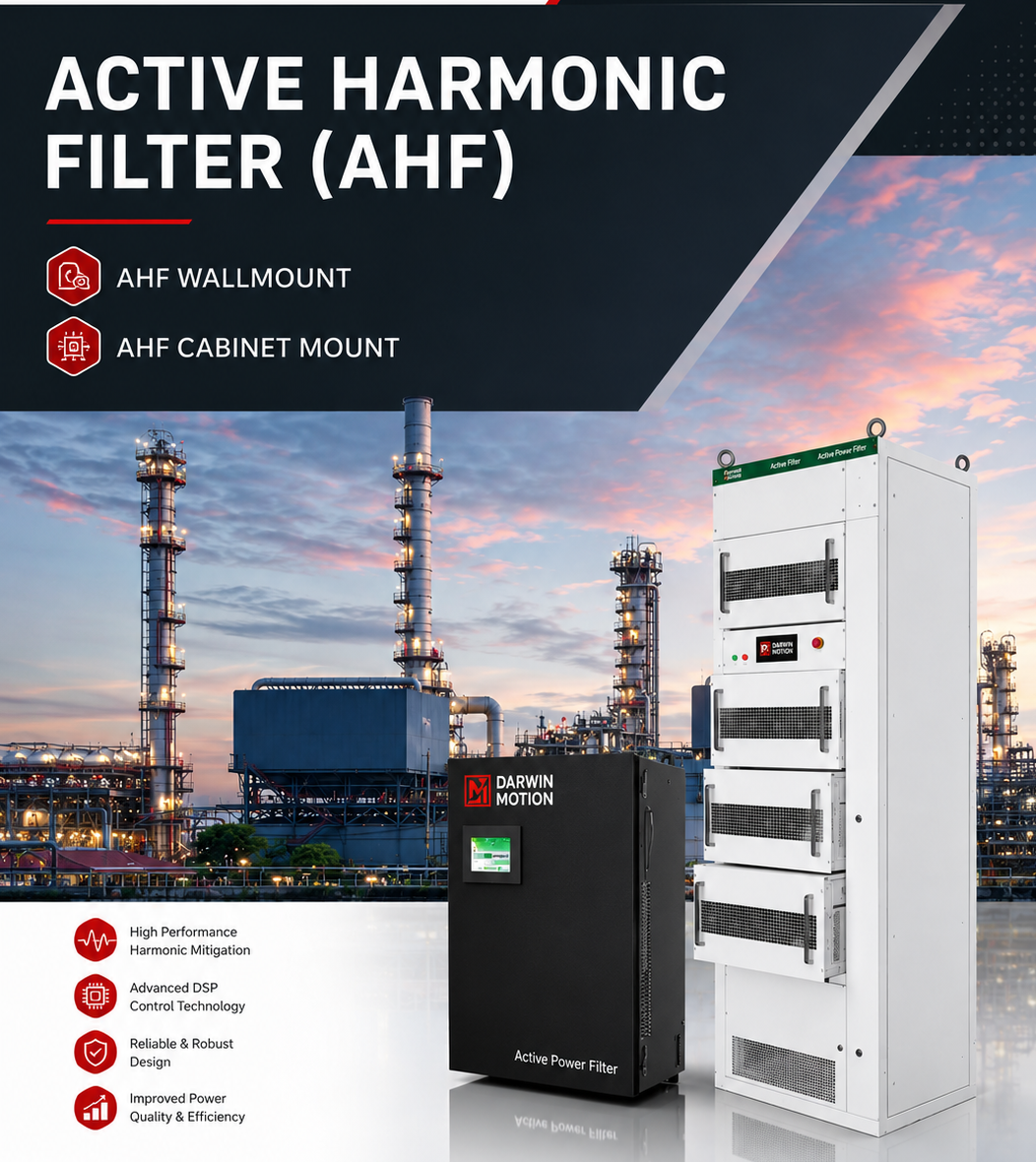
An Active Harmonic Filter (AHF) continuously monitors the electrical waveform and generates compensating currents to counteract harmonic components produced by non-linear loads.
Darwin Motion states that its Active Harmonic Filter uses real-time monitoring and compensation to mitigate harmonic currents, while also supporting power-factor improvement and three-phase load balancing.
The Active Harmonic Filter continuously measures the electrical current and identifies harmonic components present in the system.
Advanced control electronics analyze the electrical waveform and determine the harmonic currents that need to be compensated.
The filter produces an equal and opposite compensation current corresponding to the detected harmonic components.
The compensation reduces unwanted harmonic currents, helping the electrical network achieve a cleaner current waveform.
By improving power quality, harmonic mitigation can help reduce electrical stress on transformers, cables, motors and other connected equipment.
An active harmonic filter can dynamically compensate harmonic currents generated by VFDs and other non-linear loads.
Darwin Motion's AHF is designed for harmonic compensation from the 2nd to 50th order, with a stated target of reducing THDi to below 5% under appropriate system conditions.
Lower harmonic distortion contributes to a cleaner electrical environment for textile machinery, automation systems and other connected loads.
Harmonic currents can contribute to additional heating in transformers, cables and other electrical components. Reducing these currents can help minimize associated electrical losses and thermal stress.
Better power quality can support the reliable operation of VFDs, PLCs, servo systems, control panels and other electronic equipment.
Excessive harmonics can contribute to electrical-system disturbances and nuisance trips. Harmonic mitigation can help create more stable operating conditions.
Reducing unnecessary harmonic-related losses in electrical distribution equipment can support improved overall system efficiency.
Textile mills often operate production machinery for extended periods. Maintaining stable electrical conditions can help minimize power-quality-related interruptions.
Unlike fixed compensation approaches, an active harmonic filter can continuously respond to changing load conditions. This is particularly useful in textile plants where machinery loads can vary throughout the production cycle.
A Harmonic Filter for Textile Industry can be considered for a wide range of applications, including:
Darwin Motion specifically lists textile applications among the industries and applications served by its power-quality and drive solutions.
An Active Harmonic Filter dynamically detects and compensates harmonic currents. This makes it suitable for facilities where loads change frequently.
Passive filters generally use combinations of inductors, capacitors and resistive components designed for specific harmonic frequencies. Their performance can depend on system characteristics and filter design.
For textile plants with multiple VFDs and changing production loads, dynamic compensation can offer significant operational advantages.
Darwin Motion is an AC Drive and VFD manufacturer providing industrial drive and power-quality solutions for demanding applications. Its portfolio includes AC Drives, Variable Frequency Drives, Active Harmonic Filters, Static VAR Generators and other power-quality technologies.
The company's Active Harmonic Filter solution is designed for industrial environments where harmonic mitigation, power factor improvement and electrical-system reliability are important.
Darwin Motion lists system-voltage options from 208 V to 690 V AC and compensation capacities from 30 A to 600 A for its AHF range. Actual system selection should be based on a detailed electrical study and site requirements.
Before selecting a harmonic filter, a textile plant should ideally conduct a detailed power-quality assessment.
This information helps engineers determine the appropriate filter capacity and installation point.
Depending on the electrical architecture of the textile plant, an AHF may be installed at:
A centralized filter can be installed at a main distribution board or common bus where multiple harmonic-producing loads are connected.
For particularly large or problematic machines, harmonic filtering can be applied closer to the source of the distortion.
Large textile facilities may also consider dividing the electrical network into zones and applying power-quality solutions according to the harmonic profile of each section.
The optimum approach depends on the plant's electrical configuration, load profile, harmonic levels and future expansion plans.
VFDs provide essential benefits such as variable-speed control, process optimization and energy-efficient motor operation. However, because VFDs are power-electronic loads, their impact on power quality should also be considered.
Darwin Motion highlights the relationship between VFDs and harmonic distortion and notes that excessive harmonics can affect power quality, energy consumption and equipment heating.
Therefore, combining efficient VFD technology with an appropriate harmonic-mitigation strategy can provide a more comprehensive approach to textile-plant electrical performance.
A properly designed harmonic-filtering solution can help textile manufacturers achieve:
Modern textile manufacturing depends on sophisticated electrical and automation systems. VFDs, servo drives, HVAC systems, pumps, fans and automated machinery provide the speed, precision and flexibility required for competitive production, but these non-linear loads can also introduce harmonic distortion into the electrical network.
A properly selected Harmonic Filter for Textile Industry can help mitigate these harmonics, improve power quality and support reliable operation of critical textile machinery.
With its combination of AC Drives, VFD technology and Active Harmonic Filter solutions, Darwin Motion offers an integrated approach to industrial motor control and power-quality management. For textile manufacturers looking to improve electrical reliability and manage harmonic distortion, a site-specific power-quality assessment is an important first step.
Darwin Motion – AC Drive Manufacturer & Power Quality Solution Provider
From textile machinery and spinning applications to winding, HVAC, pumping and other industrial systems, Darwin Motion provides technologies designed to support efficient, reliable and intelligent industrial operations.


