Posted on 22nd Sep 2026
Modern welding machines are widely used in fabrication plants, automobile manufacturing, steel industries, engineering workshops, shipbuilding, and other industrial applications. With the increasing use of electronically controlled welding equipment, maintaining stable electrical power quality has become an important part of reliable plant operation.
Welding machines can behave as nonlinear electrical loads and may contribute harmonic currents to the power distribution network. These harmonics can affect transformers, cables, switchgear, capacitor banks, and other connected equipment. A properly designed Harmonic Filter for Welding Machine can help reduce harmonic distortion and improve overall electrical performance.
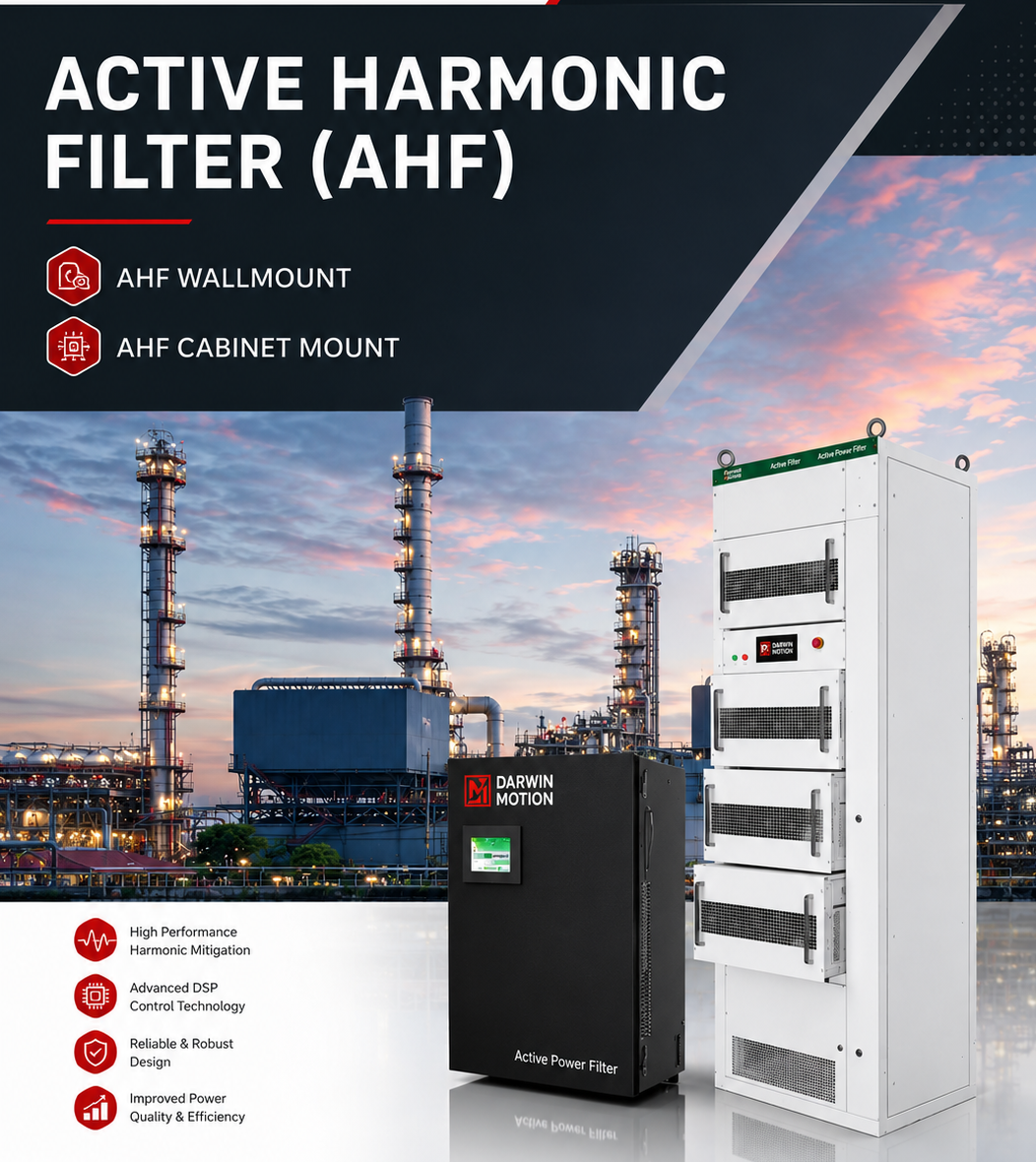
Darwin Motion AC Drive Manufacturer provides advanced Active Harmonic Filter solutions for industrial power-quality applications. Its Active Harmonic Filter technology continuously monitors electrical conditions and provides dynamic harmonic compensation for changing load conditions.
Many modern welding systems use power electronic components for controlling welding current and voltage. Rectifiers, inverters, switching devices, and other electronic circuits can draw current in a non-sinusoidal waveform. This creates harmonic components in the electrical system.
When several welding machines operate simultaneously, particularly in large production facilities, the combined harmonic current can increase the distortion level of the plant's electrical network.
Harmonic distortion can influence the performance of the complete electrical distribution system rather than only the welding equipment. In facilities with multiple nonlinear loads, harmonic mitigation can help maintain cleaner current waveforms and improve the operating environment for connected electrical equipment.
An Active Harmonic Filter (AHF) is a power-quality device that continuously measures the electrical current and identifies unwanted harmonic components. It then generates compensating currents to counteract the detected harmonic currents.
This dynamic approach makes active filtering particularly useful for welding facilities where electrical loads can change according to production schedules, welding cycles, machine utilization, and the number of machines operating simultaneously.
The Active Harmonic Filter from Darwin Motion AC Drive Manufacturer continuously monitors the electrical network through its control system. Harmonic components are detected and appropriate compensation currents are generated in real time.
According to Darwin Motion's published specifications, its AHF supports real-time harmonic compensation, reactive power compensation, three-phase load balancing, and harmonic suppression from the 2nd to 50th order. The manufacturer also states a fast response time of less than 5 ms and THDi reduction to below 5% under specified conditions. Actual performance depends on the electrical system and application conditions.
Welding-intensive manufacturing facilities can have rapidly changing electrical loads. During production, multiple welding machines may start and stop according to the manufacturing sequence. Robotic welding cells, conveyors, VFDs, compressors, CNC machines, and other automation equipment may also operate on the same electrical network.
This combination can create a complex power-quality environment. Harmonic measurements and electrical-system analysis can help determine the magnitude and source of distortion before selecting an appropriate filtering solution.
Both active and passive harmonic filtering technologies can be used for harmonic mitigation. Passive filters generally use combinations of inductors, capacitors, and resistors designed for particular harmonic frequencies. Active filters use power electronics to generate compensating currents dynamically.
For welding applications with frequently changing loads and varying harmonic profiles, an active harmonic filter can provide greater flexibility because compensation can continuously adapt to the electrical conditions.
Harmonic filtering can be considered in a wide range of industrial welding environments where nonlinear electrical loads create measurable harmonic distortion.
Selecting the appropriate harmonic filter requires an understanding of the electrical network and actual operating conditions. A generic filter rating may not be suitable for every welding installation.
Darwin Motion AC Drive Manufacturer develops industrial automation and power-quality solutions for applications involving modern electronic loads. Its product portfolio includes AC Drives, Variable Frequency Drives, Active Harmonic Filters, Static VAR Generators, and related technologies.
For welding plants, an Active Harmonic Filter can be integrated into the electrical distribution system to dynamically compensate unwanted harmonic currents. The appropriate configuration should be selected after evaluating the site's electrical parameters and harmonic measurements.
Welding machines are an important part of modern manufacturing, but their power-electronic circuits can contribute harmonic distortion to industrial electrical networks. As welding loads become more automated and production facilities use multiple electronic systems, maintaining good power quality becomes increasingly important.
A properly engineered Harmonic Filter for Welding Machine can help reduce unwanted harmonic currents, improve electrical-system performance, support equipment reliability, and provide dynamic compensation for changing loads.
With its Active Harmonic Filter technology and industrial power-quality solutions, Darwin Motion AC Drive Manufacturer provides technologies for industries looking to manage harmonics and improve the reliability of modern electrical systems.


